The Importance of Learning Archetype Astrology over the Pop Astrology of Horoscopes (for writers)
You don’t have to believe the signs determine fate in order to understand the Soul’s Journey they describe or to use them in your writing and enhance your understanding of storytelling as fans.
Writers should not be afraid to delve deeper into the twelve core archetypes that make up astrology. This isn’t about popular astrology stereotypes or birthdays; this is about fictional characters who can have any birthday you assign—this isn’t about plotting a story based on divination. Archetype Astrology concerns the broader concepts of our human journey.
These archetypes have evolved as they have traveled across many continents and through time, absorbing millions of stories into their DNA. Their well-structured combinations cover all the themes you can imagine and every character.
NOTES
You can access a table of contents on a desktop by hovering over and then clicking the stack of lines in the left margin of the screen.
Hey Grammar Police! You should know I have just given up and now use “they” for individuals. English has always lacked a gender-neutral term, and I am tired of saying him, him, him, or keeping track of how many times I use “her” and when and if it furthers a stereotype. I plan to write a post titled “My Fucking Style Guide.”
ASTROLOGY ARCHETYPES
One-third of your audience believes in astrology as science, but, as archetypes/personality types, it is embedded in your audience as a whole. You can’t find anyone who doesn’t know what their sign is supposed to be and what it is supposed to mean about them.
I just saw an interview with the actors of Fallout on Amazon Prime. When asked what sign their characters are, they all answered immediately. They chose the signs I considered their moon or rising signs as their sun signs. THAT’S interesting! However, the point is that they responded without thinking. It is built into us.
While most people do not know the archetypes as intimately as friends or family, we are all acquainted with them, and a better understanding of archetypes (AND sun, moon, and rising signs) can make stories easier to interpret and writing richer.
Start by learning these ancient archetypes and their lessons, and you won’t end up with small stories and forgettable characters. You won’t end up sabotaging yourself by subverting expectations in such a way that large parts of your audience abandon you (unless you consciously take the risk).
TROPES, STEREOTYPES, & ARCHETYPES EXPLAINED
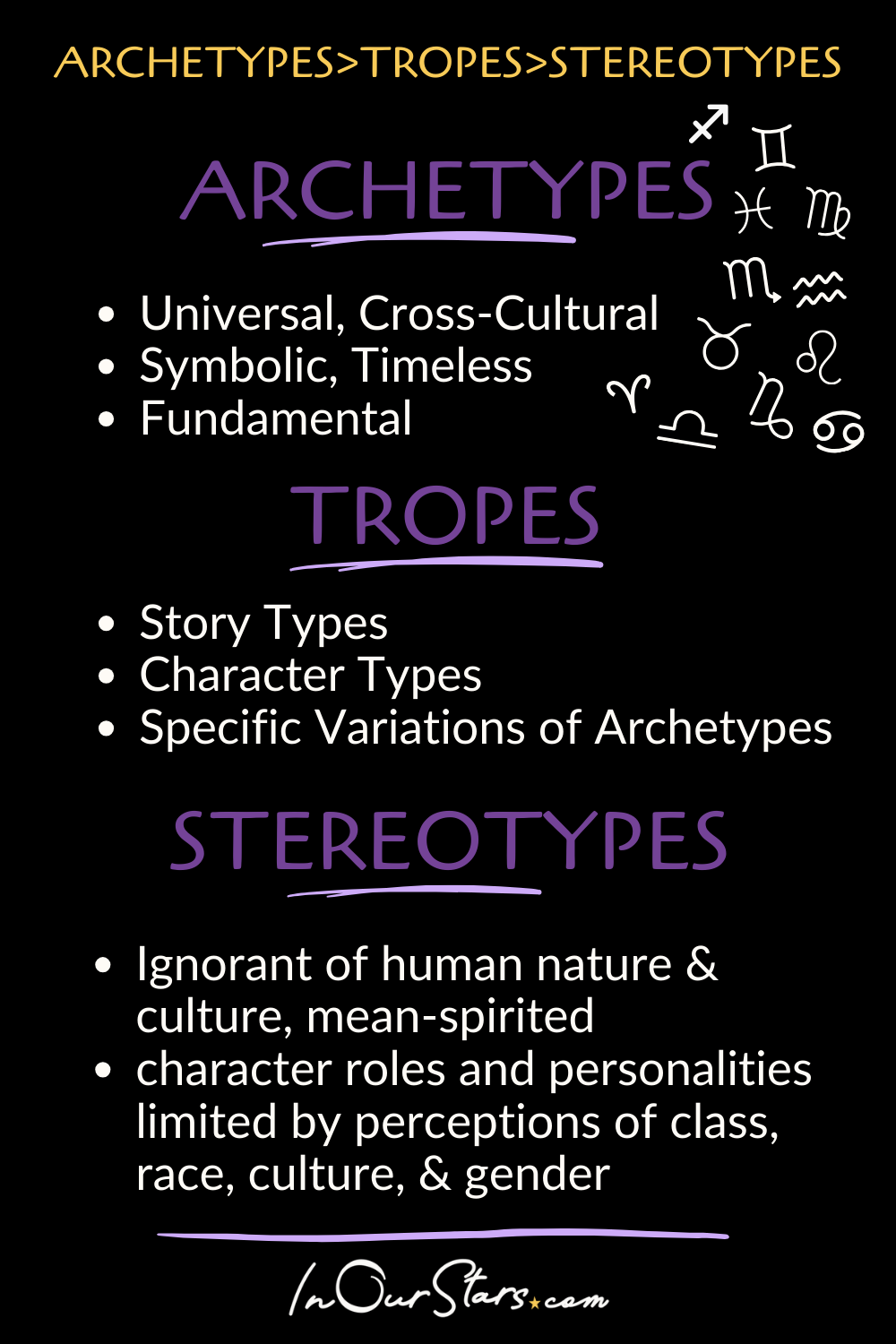
Many writers, and screenwriters, in particular, often focus on tropes—both writing them and subverting them. However, tropes are a subcategory, not a core category, and subverting them should be undertaken to create memorable, unique characters. But, know the rules first because your audience has expectations you need to thoroughly understand.
There are many books on tropes and lists of tropes for writers. There are hundreds and hundreds of character and plot tropes.
Tropes provide a framework and a way to fill in the blanks when writers are stuck, which is all well and good, but they also describe a very narrow set of behaviors that can easily become formulaic and predictable.
In building a memorable and meaningful story, the archetypes are the blueprints and lumber, and the tropes are the checklists, hammers, levels, screwdrivers, and nailguns.
Okay, give me a better analogy.
Tropes are important; they are the smaller tools that build the story. They describe a character’s role in the story. He’s a rogue, and he’s a lovable one. He is in the story to shake things up or to learn his lesson.
Tropes, stereotypes, and archetypes are shorthand for recurring characters, relationships, and plot devices that storytellers use, enabling audiences to recognize them immediately.
A trope is a type of person, not a character. It’s almost, but not quite, a stereotype. Tropes become stereotypes when over-simplified and limited. Stereotypes limit a type of person to a particular class, “race,” or gender role. The limits are the key to the stereotype. A woman can never be a lovable rogue, or called a rogue at all.
No, “rogue” is too nice a word to use, too “boys will be boys,” to use for a charming woman who plays around. You know what those women are called and what happens to them in stories. I don’t have to say it.
Stereotypes are ignorant and mean-spirited tropes that are so ingrained in our storytelling and culture that they are often invisible to most audiences.
In fact, while “woke” means a lot of things in modern culture, I think the vast majority of people use it when stereotypes in stories are flipped or subverted. Finally, people who hate those all-female or all African-American productions of Shakespeare have a word to use as a weapon.
Becoming enlightened and aware is bad? Waking up to what is going on is bad? Dramatic irony occurs when the audience knows something the characters do not. When an audience member criticizes a work of art for making them aware of a stereotype by subverting it, that is its own special form of irony.
I have noticed another phenomenon lately: when writers change the archetype used in a book to a different archetype in an adaptation, audiences rebel and call it “woke.” This is fascinating. Subverting a stereotype IS woke. Subverting an archetype is just changing the archetype. It is a dangerous thing to do, and another reason writers should understand the archetypes.
Some audience members call it "woke" because they have no other term to express their dissatisfaction. I’ll provide an example when I discuss Rings of Power (Amazon Prime), changing Galadriel from Aquarius to Leo later in this article.
Half the signs are designated as “male” (fire and air) and half as “female” (earth and water). There is no problem when we talk about the signs, values, lessons, and themes. All the signs have equal beauty and worth then. Each element has equal power and strength.
There are some problems with male Aries starting the cycle of signs. I’ll talk about that in the article about Aries in April. However, the culmination of the spiritual journey is in female Pisces, so in many ways it balances out.
But, I am talking about characters here. That’s where it becomes problematic. The sexism is built in. Because the archetype has developed across cultures and religions worldwide, the vast majority of the tropes and stereotypes that resulted are based on gender. We’ll have to talk about how that sexism becomes specific within each archetype.
For now, let’s get back to tropes.
Examples: Quests, McGuffins, Relationship Tropes
Within the larger archetypal QUEST story structure, there might be an enemies-to-friends trope, a road trip trope, or a McGuffin, or all three. The archetypes, however, go deeper.
Reminder: A McGuffin is a symbolic object that turns out to be either less important than the characters (or audience) thought or not essential to the main story.
Pulp Fiction
Do you remember what they were looking for in Pulp Fiction? I vaguely remember a glowing suitcase. In any event, it wasn’t something crucial to the themes, characters, or story arc — it was a plot device to keep things moving. It was a trope — a holy grail.
What were the bigger archetypes involved? That was all embedded in character and the choices they made. Could they find redemption? Did they want to find it?
Each astrological archetype has that decision-tree arc embedded in it, too. What kind of choices does a person who fits this archetype often make, and how does each personality grow and evolve into making better choices? What’s a “better” choice anyway?

Fallout
In Fallout Season 1 (Amazon Prime, 2024—), there is a collection of McGuffin tropes. The main characters were each looking for certain people, then one man’s head, and now, in season 2, the enemies-to-friends (we assume) pair is looking for Hank MacLean and Cooper Howard’s family. We think they will bond. We believe they will learn from each other.
Enemies to Friends Trope: Okay, sure, you cut off my finger and then sold me to an organ harvesting company, but we have a common goal now, so...
Father-Daughter Trope: There is an obvious connection here. The Ghoul is looking for his daughter. Lucy is a daughter looking for her father.
Road Trip Trope: Traveling companions bickering over their world views. How will this trip and the McGuffin they seek change them?
But what's the ARCHETYPAL internal battle arc here?
We wonder if Lucy will lose herself and her hope and idealism in the darkness and the battle to survive, the way The Ghoul has lost himself, or will she bring him back to himself, to Cooper Howard?
That’s the power of the deeper archetype than the tropes that signal its existence.
The essential story is not found in the tropes! What exactly is their common goal? We all know these characters will find something or someone much bigger than all that.
The Stakes
We already know that Finding Truth and the fight for Freedom from Tyranny (The Sagittarius Archetype) are the universal stakes that make this story so compelling.
Then there are the deepest personal stakes we all face when we are confronted with true enemies and unexpected and challenging circumstances in real life.
How can I hold onto who I am and not become someone I would dislike? How can I hold onto my values and life philosophy in the face of tremendous stress? Where and what do I need to change?

RELATED POST: FALLOUT Season 1 | The Four ♐♐️♐️♐️ Horsemen of the Apocalypse on Amazon Prime
I’m going to continue using Sagittarius as the example. Sagittarius is often written to be the hunter, or outlaw, or the reluctant hero, or the former freedom-fighting soldier, or the cowboy who either has a heart of gold or the most cynical mind possible. Those are tropes based on the archetype.
But we can also think of Sagittarius as the archetype that encompasses the bigger motivations and lessons of those characters.
Hans Solo, Star Wars: Episode IV – A New Hope, George Lucas, 1977
CHARACTER: Han Solo
ARCHETYPE: Sagittarius
TROPES: Reluctant hero, lovable rogue, freedom fighter.
In my post on Sagittarius, I talk about the common story types within that archetype. For all the signs, the story is always based on what astrologers and Jungian psychologists would call The Soul’s Journey, and that is directly connected to the character arc.
For Han Solo in Star Wars, the archetypal arc was to choose love and a worthy cause bigger than himself over personal freedom. That’s what matters.
The rest are just tropes.

RELATED POST: The Sagittarius Archetype
CHARACTER ARCS
There is an astrological, philosophical idea that a soul is born in Aries, then reborn in Taurus, and so on, around and around the wheel until perfected. It’s not really linear like that, but that’s the basic idea. It is a universal character arc.
In addition, each sign has a partner: One sign above the horizon line and the other below the horizon line. Those partners share related lessons, so integrating them is the task of the soul.
Maybe you can believe that and maybe not, but the effect it has had on our stories is profound.
The real point is that the character arc — the way characters change and grow is found in the archetypes themselves, not in the tropes.
Let’s look at two characters millions of people know.
The Lord of the Rings (Sam & Frodo)
Sam & Frodo as Tropes
On the trope level, in the story of Sam and Frodo, we find the idea that forced proximity (trope) and the fact that they have common enemies (trope) are what build these relative strangers (the master and servant trope) into lifelong friends who are like brothers (trope). There are other tropes there, but you get the idea.
Tropes, then, are smaller, but important ideas that build characterization, plot, and relationships.
Sam & Frodo as Archetypes
Within the larger archetypes, we see the steadfast, stubborn, unbreakable devotion and dedication of Sam the Taurus—an archetype that both grows within him as he begins to love Frodo and is revealed by the story's circumstances.
We also have the kindness, mercy, empathy, and determined sacrifice of Frodo the Pisces (archetype), whose goal is to hold himself together long enough to save the entire world. (Yes, Nerds, I know. Frodo and Bilbo have the same birthday. I told you, I don’t care about that.😎Bilbo is a Sagittarius, Frodo is a Pisces.)
That archetypal love/friendship story between Frodo and Sam, and what they accomplish together, is the big picture that drives our emotional connection and our abiding love for these memorable characters.
What Sam and Frodo show us is moral beauty in the face of impossible odds. They not only maintain who they are but also find themselves.
In the hands of great writers, what the characters learn and become are found within the story’s archetypes, and the key that elevates it to something universal.
Writers who do not get hung up on trope-based writing and turn to the archetypes are the writers who create something lasting.

CARL JUNG, Astrology, and Today’s Archetypes
Before I get started on Jung, let me say that my aim at In Our Stars is not to support OR debunk astrology as a science.
It’s simply to use these highly developed archetypes to help us write and understand fiction.
The influential psychologist Carl Jung put together a list of what he called archetypes.
The word “trope” wasn’t in common usage and certainly not among psychologists, so his list of “archetypes” is really a list of higher-level tropes. He just called them archetypes. Jung was strongly influenced by astrology in the trope list he developed. Jung's characterization of them as archetypes has made the two terms synonymous in the popular lexicon.
Jung’s list: caregiver, creator, explorer, hero, innocent, jester, lover, magician, orphan, ruler, rebel, sage

You can get more specific with tropes by combining them.
Examples include the hero-fool or jester (Forest Gump), the innocent ruler (Tommen Baratheon), and the hero-orphan-magician (Harry Potter), to name three among the millions of characters who embody these tropes.
You may notice that Jung identified twelve “archetypes,” but they don’t correspond to the twelve signs. As Sam and Frodo (and Pippin, Merry, and Eowyn) demonstrate, any archetype can produce a hero, however unlikely.
You could put hero, explorer, and jester under Sagittarius, for instance, but lots of other signs are known to be heroic types, and funny too. So there is no real alignment.
Some tropes are products of the dance of archetypes and other tropes. Many derive from the modern era, such as the antihero. Some were excluded from Jung’s analysis of myths and folktales.
It’s the character arc they go through that is the root of the story, and that is based on archetypes.
The journey through the planetary houses […] signifies the overcoming of a psychic obstacle, or of an autonomous complex, suitably represented by a planetary god or demon. —Carl Jung, C.W. Vol.14: Mysterium Coniunctionis
Jung compelled everyone to take a position on astrology, pro or con.
Jung reintroduced astrological archetypes into common discussions of storytelling, while simultaneously ensuring they would never be discussed in serious literary or psychological academia.
The Roman Catholic church had already turned away from its original beliefs in astrology and demonized these pagan beliefs of ordinary people as distracting from a belief in monotheism.
In reverse order, though, astrologers began to incorporate Judeo-Christian, Hindu, Taoist, and Egyptian cosmology into discussions of astrology. The archetypes kept developing.
Science, as we know it today, came along in the Enlightenment and brushed away all of that. They said, What? Your birthday determines your personality and life path? That’s not provable or real! Bah Humbug to ALL of it!
Take a Stand? What’s the Either/Or Choice?
Because Jung continued to stand by scientific empiricism — even though, to be fair, empiricism is philosophy — he and his church, other psychologists, and astronomers reacting to him helped solidify the idea that everyone must take a position on astrology: pro or con.
Two Unprovable Claims
To make that harder, Jung made two conflicting claims about astrology, confusing himself (and us).
ONE: Astrology is a symbolic, poetic language.
The first claim is that astrology is a symbolic, poetic language that can manifest in dreams and art and evoke intuition. It is part of the collective unconscious — hence it’s a set of universal story motifs and archetypal in nature.
TWO: Astrological signs for individuals are determined by math and birthdays.
Jung also believed in a mystical underpinning to synchronicity, so he used astronomy, mathematics, and the resulting Gregorian calendar birthdates to choose the signs ascribed to individuals in his “Analytic Psychology” practice.
He conducted research comparing charts of married couples to identify astrological and seasonal associations, in an attempt to demonstrate the scientific nature of astrology.
He found some statistically improbable sun-moon conjunctions and oppositions among those couples. These are coincidences that don’t prove the case, but they keep Jung and many others today from completely abandoning the claim that astrology is a science.
It [the chart] represents, in essence, a system of original and fundamental qualities in a person’s character, and can therefore be regarded as an equivalent of the individual psyche. - Carl Jung, 1955
Jung said it was the science of antiquity, even though no modern empirical scientist would say that astrology is valid, reliable, or accurate when put to the repeatable test.
For Jung, basing it on anecdotal observation and experience was enough to call it science. This also fits Jung’s view of the Soul’s Journey.
So, is astrology hogwash, symbolic physics, astronomy, psychology, or art?
Yes?
Because Jung used actual astronomy and math drawn charts, you, as Jung’s patient, could not conclude you were a Sagittarius based on your self-analysis, intuition, and the tropes you play out in life— not even based on your dreams, which Jung did regard as important.
If you dreamed you were a centaur seeking truth and freedom, Jung would look for where Sagittarius fell in your chart. He would not decide you were a Sagittarius at heart. To me, this was a real shame.
So Jung further marginalized himself (and astrology) by claiming that astrology is both science and poetry. That made it so we can’t talk about astrology anymore, even in the arts, without being pressed into taking a position: Do you believe in astrology or not? Is it real?
It would be frivolous of me to try to conceal from the reader that such reflections are not only exceedingly unpopular but even come perilously close to those turbid fantasies which becloud the minds of world-reformers and other interpreters of “signs and portends.” But I must take this risk, even if it means putting my hard-won reputation for truthfulness, reliability, and capacity for scientific judgment in jeopardy. - Carl Jung. 1958
RELATED POST: Calendar Shenanigans: The sun sign isn’t where it used to be . . .
I wish Jung had taken that extra step to the thought that, yes, we can fit ourselves into these signs and combinations of signs, but that birthdays do not determine that. Maybe his own character arc would have led him there if he had lived longer.
Today’s Jungian psychologists have a mix of beliefs. Many believe in the birthdate-based chart, and some don’t, as you might expect.
Final Q & A with Jung
What Jung observed in his study of the system for constructing an astrological chart was how complete a picture of a personality and their life lessons it provided.
It was so detailed and awe-inspiring that it made him believe in it. I’d like to ask him this, though . . .
Could that astrological chart serve as a visual language to describe a well-developed fictional character better than a live one?
Could astrology have been a myth-making and storytelling character-building and theme-building technique all along, even when people could not see it out of the original context?
Now, if someone asks your birthday, you know right away why they are asking, and you immediately sort them into a box: Us or Them. Don’t you? What if that choice is a false dichotomy, no matter how common?
What if someone asked, “What sign do you identify with the most?” There would be a pause while you tried to figure that one out. “What sign would you like to be?”
Subverting Tropes and Archetypes is Dangerous. Be careful.
Subverting tropes is fun and creative, but large sections of your audience will resist, so you must be careful.
Must romantic comedy follow a formula?
I’m thinking of the backlash against the movie My Best Friend’s Wedding (1997), starring Julia Roberts as the protagonist — or was she the antagonist?
I recommend this film. It’s a great story, but it’s more of a dramedy than it seems or was billed to be. It’s actually about the deepest aspects of the Libra archetype: partnership, justice, putting others first, etc.
Be careful with how you subvert expectations, because you might make the audience dislike the character (and its writer).
Spoiler: Bottom line: they did not follow up on the friends-to-lovers trope, and audiences reacted with displeasure.
ASIDE: I prefer to use older films in my examples whenever possible, in the hope that more people will have seen them. 70% of the surveyed population reports having seen The Lord of the Rings trilogy, so I often use that. Julia Roberts is popular, so I am hopeful you have seen this movie. If not, watch it, and you’ll see what I mean about it breaking out of the tropes and the Libra themes involved.
Is Galadriel an Aquarius or not?
I am also thinking about how the writers handled the character of Galadriel in the first season of The Lord of the Rings: The Rings of Power on Amazon Prime. (2022-)
You will have a problem with your audience when they have already decided who the character is, and you write her as a completely different archetype in the prequel.
The 8000-year-old, end-of-the-third-age Galadriel, as portrayed in The Lord of the Rings books and Peter Jackson's films, is emblematic of the highly evolved Aquarian Water-Bearer archetype — a cool, clear, community-minded, and ethereal visionary. Her power is spiritual and atomic.

The Lord of the Rings: The Rings of Power on Amazon Prime. (2022-) made second-age Galadriel (Morfydd Clark) into a hot-headed, young, egotistical Leo warrior who is also a visionary, but her power is mainly elven physical prowess and high-elf intelligence.
Okay, hang in there a minute with me on this. This actually makes a lot of sense in a character arc that spans thousands of years. Leo and Aquarius’ life lessons are linked, and one leads to the other. It also completely aligns with Jung’s analysis that, to learn our lessons, we must integrate perceived conflicts or oppositions within our nature. Leo and Aquarius are opposite on the wheel.
However, if you don’t have deep enough knowledge of these archetypes, you will write them unskillfully — and they did.
In Rings of Power, season 1, Galadriel the Leo was obsessed with her identity as a warrior, and she was focused on only one performance goal: find and kill Sauron. She didn’t direct people to do things; she commanded them with a queenly and imperious manner.
She was even (apparently) directed not to look at the people she was ordering about and pontificating to about her fiery personal obsession.
To try to make us like her, they added a fairly minor “Save the Cat” moment where she goes back to help a fellow elf who got too cold, but this wasn’t enough, and the effort fell flat. It didn’t help her fellow elves like her much either. They mutinied.
If the writers had seen what they were doing with the Leo-Aquarius archetypes, they might have known to emphasize the positive Leo traits of humor, generosity, and charm from the beginning. She teaches young soldiers and gives away her sword, but does so without humor or charm.
If the writers had thought through the archetype arc from one sign to the other a little more, large sections of the audience wouldn’t have seen a self-centered brat with a sword and decided not to like her or care what happens to her. Audiences would have liked her enough to give the writers more time to show her arc before judging it.
Only just under 40% of the audience finished season one, and 60% of the remaining audience didn’t move on to season two, which is a real shame because it was much more focused, and the acting, scene writing, and directing are chef’s kiss in many places.
There were other reasons for the audience loss as well. We should give these shows the episodes needed to tell the story (in season one, only six were needed). Still, almost all the fans I have seen online at some point mention unlikable or unrecognizable Galadriel.
For fans who finished season 2, they will have seen Galadriel getting closer to her Aquarius phase. Most of those who stayed understood how she got from A to B instinctively anyway.
However, breaking out of the archetype audiences expected to see in order to create a character arc that started in a very different place wasn’t as well planned out as the writers believed, and for many fans, it didn’t work at all.
Why do we need to know about archetypes and tropes?
Writing is hard. (No kidding, genius.) No, seriously. It’s not just that having a starter archetype or trope makes it easier; it also makes a character more understandable to an audience. It’s shorthand. That becomes the artistry of it.
I’m not saying that Rings of Power isn’t a good show overall or that subverting expectations shouldn’t be done.
They weren’t careful enough with the power of archetype when it came to Galadriel — because they didn’t know enough about them — and that is a cautionary tale for all writers and showrunners.
The better the character fits the archetype and the more specificity added by the writer, the more memorable the character will be to audiences.
There is much more to learn about these archetypes than the popular culture interpretations of their signs. Learning more in-depth astrology can help writers, directors, and actors create more memorable and relatable stories and help audiences enjoy them more, too.