The Building Blocks of the Zodiac Archetypes
The arc of history bends toward story. Where do the archetypes come from? From basic traditional building blocks to modern gaming and karma...well, it’s complicated.
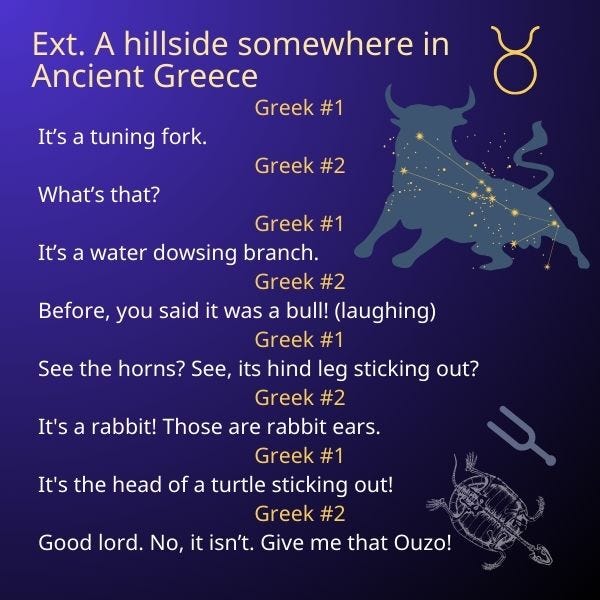
When I describe the core building blocks of each archetype, I am not starting with Babylonians, Hellenistic Greeks, or Egyptians on a hillside at night connecting the dots of constellations. Well, I am, but only for the purposes of humor. We have no idea how they made those decisions, when, or even if the Babylonian seed drill was the inspiration for the original Aries constellation, before the ram became the symbol. That is entirely my conjecture, as far as I know.
I saw a picture of a seed drill and knew the (wealthy) Babylonian astrologers called the constellation “The Hired Man” because it signaled the time to hire people to plant and care for animals.
What we know for sure is that Aries and the Northern Hemisphere birth of the year in spring were one and the same. Procreation is the enduring theme of the archetype. That is what I will focus on most: basic symbols and enduring meaning. It is the ram, not the seed drill, that most influenced that archetype.
I will cite a few sources for each inspiration for the archetype in the articles dedicated to them, but I will not provide any academic analysis. I may mix up which culture said what about whom. I’ll include links if you want to follow up and get the history all straightened out. That is not my focus. I don’t think all that’s crucial to storytellers today.
⭐Learn more about the history of astrology itself (not the archetypes or signs) and how it evolved in this article about Planetary Science in the Oxford Encyclopedias.
We know the symbols and metaphors that build the archetype have changed and continue to change. It’s the themes, lessons, values, and personality types that stay true across the centuries.
Basic Symbolic Building Blocks
Historically Associated Planets or Celestial Bodies (sun, moon, asteroid)
Element (fire, earth, air, water)
Constellation Symbols - object (scales) or animals
Modality of the Sign (Mode of Expression - Cardinal, Fixed, Mutable)
Sounds like a simple combination, but as the associated characteristics of these building blocks evolved through interactions with myriad cultures and were debated and integrated by astrologers, astronomers, storytellers, and philosophers across the centuries, a unique picture of each sign emerged.
Elements: Fire, Earth, Air, Water
The elements of fire (heat, light), air (sky, wind), earth (stone, metal, earthquakes), and water (rain, wood, flood) are recognized in every culture worldwide and are associated with distinct emotional, personified characteristics. Fire is passion and energy. Earth is practicality and groundedness. Air is thought, logic, and communication. Water is emotion and intuition.
Modalities: Cardinal, Fixed, Mutable
The modalities of the signs are a way to describe similar modes of expression between pairs of opposite signs on the wheel.
Aries & Libra, Cancer & Capricorn are Cardinal Signs. The key attribute is initiation. They represent the idea-generation and leadership start-up phase of the creative process.
Taurus & Scorpio, Leo & Aquarius are Fixed Signs. The key attribute is tenacity. The Fixed Signs represent the building phase of the creative process and craftsmanship.
Gemini & Sagittarius, Virgo & Pisces are Mutable Signs. The key attribute is adaptability. The mutable signs represent the revision (transformation) phase of the creative process and the distribution or communication of the resulting work.
When indigenous people from places like the Americas and Asia (and Australia and New Zealand) incorporated European astrology into their own religions and mysticism, all those associations with the natural elements evolved. For instance, Virgo’s association with Mother Earth, plants, and growing things expanded.
The Planets We Know (both rocky and gas) and Celestial Bodies (Sun, Moon, Asteroids)
Some signs began with a single association; as planets were discovered and named, they added another, and consequently, the archetype evolved.
Scorpio: Mars + Pluto
Aquarius: Saturn + Uranus
Pisces: Jupiter + Neptune
Some planets rule two signs even today:
Mercury (Gemini, Virgo)
Venus (Taurus, Libra)
⭐SEE ALL POSTS on the Archetypes
Astrological Sexism
Only one planet was named after a woman, and the woman they chose was Venus: beautiful, sexy, and a traditional “Good Mother” of cherubs. They didn’t choose Athena or Minerva, the goddesses of wisdom. They didn’t pick Justitia, the goddess of Justice. They certainly could have. Venetia Burney, an 11-year-old English schoolgirl, named Pluto in 1930. When we talk about rulers of signs, we can’t forget all that.
This evolutionary process was neither linear nor logical, and a lot of sexism is built in. Libra is considered a masculine air sign ruled by Venus, so over time, Libra, as an archetype, was softened.
How would the archetypes differ if we had chosen other celestial bodies, such as the asteroid Athena (which could have been named Minerva if we were sticking with Roman deities) as the ruler of Libra, or Hecate as the planet now called “Pluto”?
I am certainly going to be making a case for letting astrology become as “woke” as our storytelling has become and needs to be.😏
Why Every Association Cannot Be Identified and Described Here
There are many cultural influences on the zodiac’s archetypes from across Asia, Europe, North Africa, and the Middle East. It’s practically impossible to determine the full extent of the influences on every philosopher, storyteller, astrologer, and astronomer who served as a collector and shaper of these disparate cultural elements that originally defined the archetypes of each sign.
The complexity of origin was only compounded as the archetype’s development continued through history. For example, it expanded and evolved again following contact with indigenous cultures of the Americas, as those stories, arts, and gods were incorporated into the minds of philosophers, storytellers, and astrologers who have discussed and written about astrology since the 1400s. The synthesis and feedback loop of cultures has continued to inform the archetypes and storytelling.
Philosophers, storytellers, and astrologers were not (and are not) passive recipients of information but active interpreters, adding their own cultural lens, philosophical views, and personal biases to the incoming ideas.
Religion, mysticism, and metaphysics have a dynamic relationship with astrology, and all of these also contribute to contemporary storytelling.
Comics, graphic novels, and video games introduce an additional dimension by labeling characters specifically according to moral inclinations. It’s not really about their personality traits; it’s more about predicting how they will act.
⭐RELATED POST: WHY Learn Archetype Astrology? (Even if You Don’t Believe In It.) A: Do you want to design a game? Write a screenplay? Understand why certain characters do what they do?
Gaming Character Tropes & Examples & the Moral Path
Lawful Good: Teachers, paladins, knights, idealistic superheroes
Chaotic Good: Rebels, freedom fighters, and tricksters who think it's good for everyone if they shake things up.
Lawful Neutral: Characters willing to bend the rules when necessary to achieve the collective good.
Chaotic Neutral: Mercenaries, opportunists, lone wolves, and other characters who do what they need to do to benefit themselves.
Neutral Well, it depends.
Villain Types: Tyrants, Cynics, Schemers, Anarchists
Many people confuse tropes and archetypes, but each of the above gaming categories can fit into the bigger categories of each zodiac sign. You can have a Sagittarius who is lawful good, or chaotic good, or a cynical villain who has become a lone wolf. The freedom and truth aspects of the archetype can bend in any direction.
Karma
Many people think of karma as “What goes around, comes around” and believe that’s true in a religious sense. Christians believe the consequences will come one way, and those who believe in reincarnation believe it comes in another way. I will not address it in those terms, although I will discuss the broader context of the twelve signs as a pathway from one lesson to the next and from one character arc to the next.
If anything, I’ll approach it in a manner similar to the Roman Stoics, who also influenced the philosophy of astrology.
The moral actions of each sign fit into a deeper understanding of karma. Karma in the astrological sense is not destiny or poetic justice as many people use the term. It’s the consequences of your actions and the lessons you learn from them.
All our thoughts and actions, and their consequences, form a complex tapestry that we can never unravel, and we cannot point to this or that as the cause or consequence. We can’t do it for ourselves, so we certainly shouldn’t try do it for others—except inside our stories.
Philosophy
Philosophy and psychology are my focus here. If writers sit around in a writer’s room drawing from the Myers-Briggs personality tests or astrological karma, that is the conversation I am diving into. Everything is connected somehow to everything else.
Astrology is the name given to a series of diverse practices based in the idea that the stars, planets, and other celestial phenomena possess significance and meaning for events on Earth.
It assumes a link between Earth and sky in which all existence, spiritual, psychological, and physical, is interconnected. Most premodern cultures practiced a form of astrology.
A particularly complex variety of it evolved in Mesopotamia in the first and second millennia BCE from where it was imported into the Hellenistic world from the early 4th century bce onward. There it became attached to three philosophical schools, those pioneered by Plato, Aristotle, and the Stoics, all of which shared the assumption that the cosmos is a single, living, integrated whole. -Nicholas Campion (bold and italics mine)
It’s Complicated
Like the interconnected threads of karma, the process of astrological archetypal evolution is so complex and dynamic that, as storytellers, we can learn and take in as much knowledge as possible, and then respond intuitively in the end.
Such is the creative process. It’s good to have lots of tools in your toolbox. This continuous change ensures that each of these archetypes is a living, evolving entity.
We cannot know—nor need to know—how everything connects to everything else. We only know that it does.