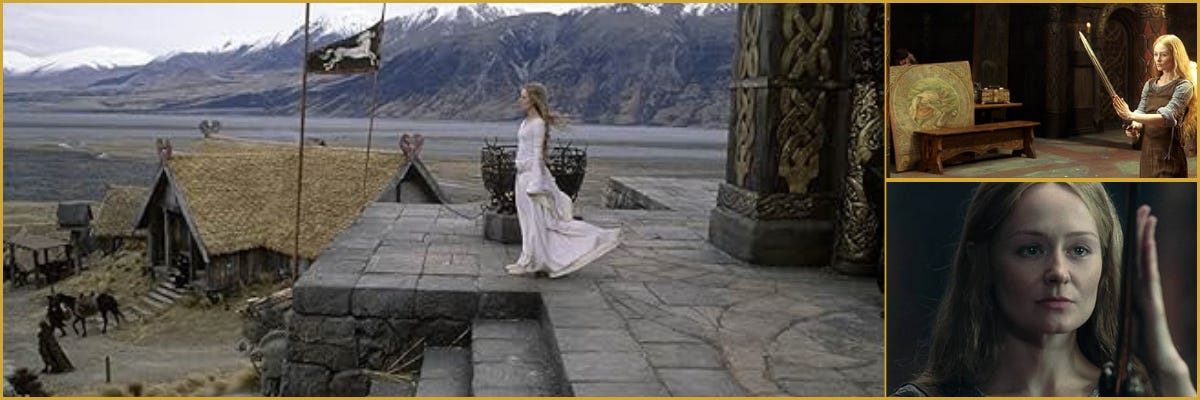
♐CASE STUDY: Eowyn of Rohan
Courageous, independent, and fierce. The model for warrior princesses everywhere.
I think I was thirteen when I first read The Lord of the Rings by J.R.R. Tolkien. I was enamored of one male character after another. But it was Eowyn who made me decide to love Farimir. After all, it seemed like he was going to allow her to be her non-housewife self and still love her.
In the 1960s, that was never a sure thing for women, and I was very worried about it. Eowyn and that Sagittarius archetype gave me hope. Hope is a gift of Jupiter, after all. Even Eowyn’s struggles with courage and hope gave me courage and hope.
“All your words are but to say: you are a woman, and your part is in the house. But when the men have died in battle and honour, you have leave to be burned in the house, for the men will need it no more. But I am of the House of Eorl and not a serving-woman. I can ride and wield blade, and I do not fear either pain or death.”
“What do you fear, lady?” he asked.
“A cage,” she said. “To stay behind bars, until use and old age accept them, and all chance of doing great deeds is gone beyond recall or desire.”
― J.R.R. Tolkien, The Return of the King
(Contains Spoilers) The “White Lady,” Eowyn of Rohan in Tolkien’s The Lord of the Rings, fits the Sagittarius archetype, but not the stereotype. They refer to her as the White Lady because her skin is exceptionally pale, even for Rohan. It’s not really about her race. Also, in keeping with the Sagittarius type, she is exceptionally tall and strong, like her brother.
Blunt and Defiant
When Aragorn tries to smooth the order that she remain with the women and children while the men go to fight, she dismisses the future King of Gondor’s words bluntly. She is defiant. She will fight for her own freedom and that of her family and nation. When she is ordered not to, she dresses as a man and goes anyway. That is as Sagittarian as it is possible to be.
Eowyn is a woman considered “feminine” who is also a defiant, freedom-loving, and skilled warrior. Women pretending to be boys or men so they can be their true Sagittarian selves is a trope in itself. Arya does it as well in Game of Thrones.
Independent and Fierce
Eowyn is a Lady of Rohan. The tribes of Rohan could be compared to the tribes of the Northern Plains of North America in the 18th and 19th centuries. Like the Comanche, the Rohan were fierce horse-lords and warriors. Take a fierce warrior and order him to stay home and care for the children just before a desperate battle his family will lead. See what happens.
Eowyn did not simply end the fighting by killing the Witch King; she fought bravely before that. Many people forget that before Legolas brought down an elephant in the films, Eowyn and Merry did so. When she could have been trampled, she rode her horse skillfully under it and through its legs, cutting its muscles and sinews until it fell.
Soldiering Onward
The battles in Middle-earth did not begin during the events of The Lord of the Rings. Eowyn could probably ride as soon as she could walk and wield a blade not long after. Her father was killed by orcs when she was only seven years old. Her mother died of grief, which certainly would have felt like abandonment to a child that age.
Eowyn and her brother Eomer were adopted by and loved dearly by their uncle, Theoden, the King of Rohan, but Theoden also abandoned Eowyn when he disappeared into an almost fatal, hopeless despair.
Theoden was manipulated and possibly slowly poisoned by Grima Wormtongue, who was working on behalf of the cynical villain Saruman. Eowyn would have been about 19 to 24 when this was happening. Yet, Eowyn bravely soldiers on through all of her difficulties and is there for Theodren when Gandalf rescues him.
Eowyn’s brother was almost a teenager when his parents died and could work out his grief on the battlefield with the camaraderie of his cousin Theodred, the heir to the throne. This left Eowyn alone and powerless to care for her uncle. A cage, indeed. When she meets Aragorn, she begins to dream of escaping her cage to become a queen with power over her own life.
The Rohan were known to be a serious people, but Eowyn herself—in spite of everything— is cheerful with her family, with Aragorn, and with Merry. It is also true that Eomer, who almost seems like a twin Sagittarius, was known to laugh in battle.
Courageous and Determined
I continue to see online comments calling her “selfish” and “ambitious” for choosing to defy orders and riding out to fight. Some audiences regard it as a sin for her to seek glory in battle. Eowyn should do it for a man or father she loves, not glory. She chooses “all of the above.”
No one would accuse a young man of her age, who did and said the same things, of those qualities. For him, it would be expected. If the character were male, the focus would also be on the outcome: Eowyn, with an assist from Merry, killed the Witch King of Angmar, something only they could do because they weren’t men. Women are collaborative, don’t you know.
Sagittarians aren’t known for being the brave warriors that Aries are. The main warrior archetype is of a young, fearless Aries. Sagittarius is knowledgable and therefore terrified. That distinguishes bravery and courage. You are afraid, but you do it anyway. The brilliant Miranda Otto, who plays Eowyn in the films, shows us her terror, even as she confronts what she fears.
Eowyn has suffered greatly from the effects of war and loss in her family. She goes to battle with full knowledge of what might and probably will happen. It’s so much easier to say you want death—giving you control over it—than it is to face a death you fear. So, she says she wants a glorious death.
When she faces the Witch King, she is terrified. But she remains bold and strong in the face of her own fear. That is her courage. She saves her uncle from an ugly and horrifying death and saves her people from tremendous suffering and slavery.
Grief
It is not until Eowyn has killed The Witch King in a terrifying melee, Aragorn rejects her, and Theoden is mortally wounded in front of her eyes and dies in her arms, that she finally bows to the reality of the toll of the grief of her many losses and her shellshock (PTSD). Tolkien called all that “the black breath” of the touch of the Witch King, but we know what it is.
She is weak and wounded. The war has ended. Who will she be if she can’t be a queen who decides her own fate? Who will she be without her sword and the next fight ahead?
Eowyn thinks there is no freedom or love in her future, so she fights the healers for quite a while before accepting their help. In fact, she does not accept help or advice very well from anyone at all until Faramir.
“And again she looked at Faramir. ‘No longer do I desire to be a queen,’ she said.”
Archetype or Stereotype?
Eowyn is a unique character rooted in archetype, not a stereotype. Some of the plot tropes could indeed be called stereotypes, but not Eowyn herself.
Tolkien could not resist using her to show Aragorn’s kindness and then hooking her up with Faramir after they have a slightly problematic conversation where he tells her she is wrong about everything, but he loves her anyway because she is fierce and beautiful.
One trope is that a man has to straighten her out. Also, the taming of the shrew trope is present, if mildly delivered. It’s only one or two problematic sentences in which she volunteers that she will give up the shield and suggests it’s the right thing for a woman to do, and she finally accepts it because of Farimir’s love.
In spite of that, I am happy for Faramir and Eowyn to find love and peace. It is definitely a scene that would be written differently by a modern woman, but Tolkien meant well, and I don’t accept that she is ‘tamed.”
When Eowyn uses the word, she wonders if a Lord of “civilized” Gondor would be said to have tamed a wild, savage, horsewoman of the plains, so that’s a different kind of trope stereotype.
At any rate, brave Eowyn decides to love, live, and find her way in a post-war world, as any veteran must.
And hey, Faramir is articulate, romantic, and hot. What’s not to love? They both deserve love. I’ll allow it.
A Profile in Courage
The character arcs of both Farimir and Eowyn are toward healing. Neither one will continue as warriors. Eowyn helped make Disney princesses Mulan, Raya, and Merida possible, letting little girls dream of becoming warriors and finding love.
Speaking of gender-neutrality (Weren’t we?). In astrology, fire and air have been considered “masculine,” and outward-facing, and earth and water are considered “feminine” and inward-facing, but you know, fuck that.


Love how you framed Eowyns arc through the courage vs bravery distinction. The Wormtongue manipulation angle adding years of powerlessness before the main story even starts makes her decision to ride out way more layered than just wanting glory. Watched the extended cuts last month and Miranda Otto's performance in the Witch King scene really does show that terror underneath. The whole cage metaphor lands diferently when you realize she's been traped in multiple ways simultaneously.